
The upcoming 99th PBF course will take place in Cotonou from November 30 to December 12, 2026.
Please find attached the announcement (annonce du cours) and registration form (fiche d’inscription).
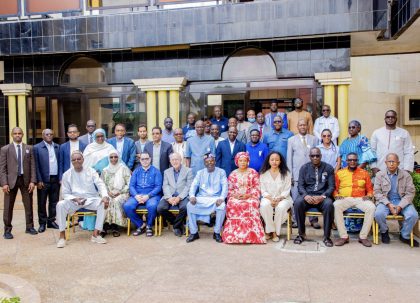
The 32 participants are from 6 countries, along with the facilitation team
The 97th international course, held in Cotonou from June 30 to July 12, was a success and drew 32 participants from six countries. The largest group came from Mauritania (15), followed by Mali (13), the DRC (1), the CAR (1), Chad (1), and Niger (1).
The facilitation team provided feedback on group action plans from the start of the course. This allowed groups to revise and improve their action plans up to four or five times, improving their quality.
Hereby, the course report (rapport)
1. Some impressions of the course
Fifty-seven percent of participants felt the two-week course was too short, as was the time allocated for discussions and group work. Participants found the modules on microeconomics, health economics, and theory difficult.
The average final test score was 73.3%, slightly lower than the averages from previous Francophone courses. There were seven distinctions (90% or higher), 25 merits (53% to 87%), and two participation-only results (50% or lower). Women were significantly underrepresented in the course, with only four participants; however, their average final-test score was 79%—six points higher than men’s.
2. Evidence that PBF yields good results – also to target the poor
In 2024 and 2025, three World Bank project completion reports showed that PBF (Performance-Based Financing) has achieved excellent results—in both quantity and quality—in Burundi, Zimbabwe, and Mali over the past 20 years.
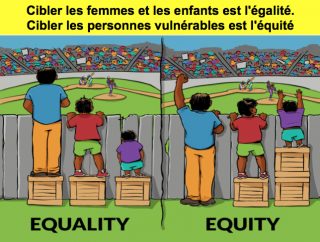
Equality subsidizes the wealthy. Equity targets the vulnerable and is more efficient
Furthermore, support for vulnerable populations in Mali has improved significantly thanks to the full implementation of PBF equity mechanisms (Bagayoko et al., 2025). Health facilities were paid on time. This is crucial, as health facilities must initially pre-finance the free care provided to vulnerable individuals. Cameroon also fully implemented the PBF equity instruments. Yet, payment delays of more than one year have hindered support for vulnerable populations (Nkangu et al., 2022).
In 2026, another PBF intervention-versus-control study in Chad—covering nine million beneficiaries—yielded significant results for 19 out of 27 output indicators and showed quality improvements ranging from 14% to 36%. This success came despite a relatively low feasibility score of around 60%, suggesting outcomes could be even stronger with a better-designed PBF program in Chad.
In conclusion, substantial and growing evidence shows positive PBF outcomes across various countries and contexts.
3. Why, then, do countries not embrace PBF reforms more fully?

The sacred forest in Ouida, Benin
The primary reason appears to be that central authorities prefer to retain control over inputs rather than make direct, results-based payments to providers, district management teams, community associations, and other stakeholders within the PBF system.
A secondary reason is that some academic articles have questioned PBF’s merits. However, we believe this criticism was unfounded, as those academic studies were based on flawed PBF conceptual designs.
To address this, SINA Health has spent approximately twelve years developing a feasibility scoring tool comprising 23 criteria. A low score reduces the likelihood of success; SINA Health recommends a score of at least 80% to ensure a successful outcome.
4. Mauritania
The Mauritania group was the largest, with 15 participants. The PBF scheme is currently being scaled up to cover 80% of the population and will also include part of the capital city, Nouakchott.
Participants from Mauritania noted that the RBF feasibility score remained low at 44%. Key issues identified included the absence of quality improvement bonuses (QIB), a low state contribution (10%), a monopoly on medicine distribution, the failure to factor the geographical equity bonus into provider payment calculations, overlapping roles (between the Regional Verification Entity and the Regional Council) and procedures, and the existence of redundant bodies. The group developed a robust advocacy plan to improve the PBF scheme’s conceptual design in Mauritania and proposes scaling it up to 100% nationwide.
5. Mali

The Mali participants
Thirteen participants from Mali attended the training, and one self-funded their participation. The Malian group comprised three members of the PBF national steering committee, along with representatives from eight regions and two districts. Five Malian participants achieved a distinction (above 90%) in the final exam. The Mali group played an important role during the course and contributed to highly engaging discussions.
Their action plans focused on ensuring PBF sustainability in Mali, planning action research on urban PBF, and addressing mechanisms and instruments for emergency PBF.
The urban PBF initiative about to launch in Bamako’s District VI requires an approach tailored differently from the traditional model. PBF has successfully piloted the urban approach in Douala and Yaoundé; this approach relies primarily on public-private partnerships and ensures non-discrimination in allocating PBF contracts.
5. Chad
A staff member from the World Bank office in N’Djamena attended the course and played a key role in explaining PBF to the other participants. His action plan focuses primarily on PBF’s long-term sustainability in Chad. He shared an evaluation report on the PBF-control group intervention, which strongly supported the PBF approach.

River crossing in the Central African Republic
6. Central African Republic
The CAR representative, who attended on a self-funded basis, is responsible for vaccination programs in the country. He developed an action plan to make better use of PBF tools to improve vaccination rates and to conduct action research on this subject.
7. Niger
The representative from Niger works for an NGO that serves as the country’s Contract Development and Verification (CDV) Agency. He identified several conceptual and organizational issues within the PBF program in Niger. He developed an advocacy action plan to accelerate PBF rollout in Niger. We are observing growing interest in Niamey—particularly from a new team within the national PBF technical unit—in advancing the PBF agenda.
8. Democratic Republic of the Congo

Conducting household surveys in South Kivu Province
The DRC representative works as a World Bank consultant.
He developed an action plan on how the DRC government could better integrate emergency PBF instruments into the national PBF program, which covers much of the country.
