
The 92nd international PBF course took place at Benin Atlantic Beach Hotel in Cotonou, with 32 participants from three countries. Here is the final report of the course (rapport final).

The 32 participants from Mali, Guinea-Bissau, and Benin
The 16 participants from Mali were the largest group, including nine from the contract, development, and verification agency (CDV) Koulikoro, three District Medical Officers, three providers, and one from the University. Among the 10 participants from Guinea-Bissau, there were two from the World Bank Project Implementation Unit and eight from the Ministry of Health. Benin was represented by five persons from the accounting firm COFIMA, and one person from MSV (Médecins sans Vacances).
Thirty-two participants took the post-test, and the average score was 71%, an improvement of 25% from the pre-test (46%). Nine participants earned a Certificate of Distinction with a score of 90% or higher on the course post-test. We also congratulate Ms. Armelle Carine GABA, who scored 100% on the final test.

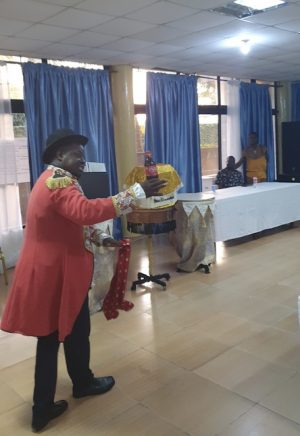
Acrobats during the closing ceremony
Participants evaluated this course very well, with daily and final scores higher than previous French-speaking courses. This is probably because most participants self-financed their stay. This time, the Benin Atlantic Beach Hotel was also better prepared to receive the participants than in previous courses.
This course was also historic in the PBF community, because we welcomed the 3000th participant since the first course in 2007.
This was Jessica Vanessa da CUNHA, the social expert from the Bank’s Project Coordination Unit World in Guinea-Bissau.Recommendations from participants and summary of group action plans
1. Republic of Mali
 Mali covers 1.2 million km² and has 20 million inhabitants, with an annual per capita income of only 770 USD. Health coverage and care quality are low, and unqualified staff often provide care.
Decades of implementation of several reforms, before PBF started to expand in 2016, have not significantly improved impact indicators such as crude mortality, maternal mortality, and infant and child mortality.
Health system problems in Mali before PBF
Insufficient health personnel and inadequate geographical distribution of human resources. The private sector’s contribution to improving health outcomes remains limited because the government prefers to support the public sector. The national public pharmaceutical supply system performs suboptimally. National public health spending ($7 per capita) represents less than 1% of GDP. Prepayment systems remain fragmented and cover only about 13% of the population. On average, Mali has only six qualified personnel per 10,000 inhabitants (the WHO standard is 23).
This situation is worsened by the political-security crisis, with persistent insecurity making it difficult to focus on health services in certain regions (especially the north and center).
Performance-based financing (PBF) reform in Mali
To address these problems, Mali embarked on PBF reforms, which underwent two pilot phases in the Koulikoro region. The budget planned for the component “Strengthening Health Service Delivery (RPSS) 2020-2024 through performance-based financing” is USD 66.4 million (IDA USD 34 million, USD 3 million from the GFF, and USD 29.4 million from the Netherlands).
The following successes of the PBF reform were observed: i. improved service quality; ii. an increase in key service delivery indicators; iii. staff motivation; and iv. improved retention in rural posts. A new phase of the PBF begins in June 2024, and the group from Mali proposes to advocate strongly to authorities and partners to continue the PBF as the preferred strategy.
From the Malian participants’ perspective, there is no plan B for the PBF approach to achieve Universal Health Coverage.

Courageous participants in the Pythons Temple in Ouidah
More specifically, the Malian group proposes to the Ministry of Health and Social Development and the CTN :
- Extend PBF implementation across the entire nation.
- Advocate with the Minister of Health and Social Development, the Minister of Economy and Finance, and the Health Commission of the National Transition Council (CNT) for the State’s contribution to financing PBF to ensure its sustainability.
- In particular: i. A 20% financial contribution from the State to the PBF program’s total expenditure; ii. Advocate with the Minister of Economy and Finance for the transformation of certain government budget lines (such as the delegated credits, infrastructure) towards PBF subsidies for the health facilities; and iii. Advocate with the National Transition Council’s health commission to mobilize resources for implementing a national PBF program.
- Promote competition between public and private health facilities and give more opportunities to the private sector to obtain (PBF) contracts.
- Make performance contracts with the central directorates of the Ministry of Health and Social Development.
- Reduce the number of output indicators from 51 to fewer than 40, in line with PBF best practices.
- Align the ratio of verification officers per main health facility contract holder with international standards (1 medical verifier for 15; 1 community verifier for 30 health facilities).
- Recruit infrastructure verification officers in the new PBF project (1 per 500,000 inhabitants covered by the PBF).
- Revise the national PBF manual to implement the above recommendations.
- Advocate to the Departments of Higher Education and Research and National Education to integrate the PBF into the training curricula for doctors and paramedics.
- Advocate to the Regional Health Directorates of Koulikoro and Ségou to include the two health centers on the university campuses (Kabala and Ségou) under PBF contracts.
- Advocate with the national PBF Unit and the MESRS to formalize an operational framework for action research and the dissemination of study results.
At FENASCOM
- Create binomial contracts in which only the Technical Director of the Health Facilities (DTC) signs contracts with the CDV Agency, rather than both with the President of the ASACO and the DTC.
- Make the separation of functions effective at the community health center (CSCom) level and give the medical officer in charge of the health facility autonomy over daily management.
2. Republic of Guinea-Bissau

Ouidah church opposite the Pythons Temple
In 2022, the country’s population was estimated at 2.1 million inhabitants, with an annual growth rate of 2.2%. In 2019, the life expectancy at birth was 59.4 years. In 2018, approximately 35.7% of the population lived in urban areas and 64.3% in rural areas.
Administratively, the country is divided into eight regions. The westernmost regions are the most populated. Religious diversity is significant, notably with animist, Muslim, and Catholic religions. Ethnically, although there are between 10 and 30 ethnic groups, over 85% of the population belongs to one of five ethnic groups. The official language is Portuguese, but Creole is the most widely used language for oral communication.
Problem analysis
- Unequal distribution of human resources due to poor working conditions in rural areas.
- Lack of a clear definition of tasks and obligations of health professionals and the treatment protocols for illnesses.
- Inadequate investments in health infrastructure.
- Lack of autonomy in managing health facilities, including hiring and firing human resources.
Recommendations
- Advocate with government representatives to prepare and implement a PBF pilot project covering approximately 1 million people (= 50% of the population), with an emphasis on rural areas and a smaller proportion in urban areas.
- The per capita PBF budget should be at least $4 per person per year.
- Advocate to the government to contribute at least 20% of the required PBF budget to the national PBF program.
- Jointly analyze the budget proposal with the Ministry of Health’s financial director, aiming to transform some Ministry of Health budget lines into PBF budget lines.
- Propose to the ministry a mission to exchange experiences with countries that have already implemented PBF, identify best practices, and learn from their successes and mistakes.
- During the pilot project’s initial implementation phase, create a Contract Development and Verification Agency (ACV in French). Contract this agency to work within an existing health insurance agency in the country. This avoids lengthy contracting procedures and overlapping institutions.
- Officially appoint the already existing national PBF Unit (CTN in French).
- Organize a PBF course in Portuguese and train the national PBF Unit members, in particular.
- Develop the Guinea-Bissau PBF manual.
- Implement PBF best practices.
3. Benin
3.1 COFIMA

Participants visiting the Benin Amazone statue
COFIMA is an accounting firm that conducts various activities, including auditing development projects. As such, COFIMA carried out several missions, including counter-verification missions. Furthermore, COFIMA has carried out verification missions on behalf of several donors for projects/programs implemented under the Performance-Based Contracting (PBC) format, which is similar to the PBF approach.
Recommendations
- Advocate for the rapid return of the PBF approach to Benin.
- Implement PBF, in its pure form, in at least one department in Benin, in conjunction with health/education NGOs.
- Map the countries where technical and financial partners or governments implement and finance PBF.
- Associate the COFIMA audit firm with CDV teams during verification missions.
3.2. Doctors without Holidays
Médecins Sans Vacances (MSV) is a Belgian NGO active in 5 African countries (Benin, Burkina-Faso, Burundi, DRC, Rwanda). One of MSV’s objectives is to strengthen partner hospitals’ capacities so they can deliver higher-quality, patient-centered medical care. MSV uses a strategic planning approach, and each partnership begins with an in-depth analysis of local needs and capacities. This analysis is then translated into a renewable 3- to 5-year Capacity Building Path (TRC). In Benin, Médecins Sans Vacances collaborates with seven (07) partner hospitals.
The main problems are that the strategy has not changed much across the TRC phases and that resource allocation does not correlate with partner hospital performance.
Recommendations:
 Make hospitals understand that it is no longer a question of obtaining fixed resources in terms of subsidies/support from MSV but that that resources will be given based on the performance of the health facilities.
There are several options:
- Establish a Quality Improvement Bonus (BAQ in French) mechanism during 3 Capacity Building Path (TRC in French). One cycle lasts 3 years. We completed a first three-year Capacity Building Path, followed by a second; from the third TRC onward, we will add the PBF Quality Improvement Bonus mechanism.
- We will correlate MSV support with the performance of partner hospitals. The annual hospital support budget will therefore be used to allocate the subsidy each quarter according to the quantity and quality performance assessment.
