
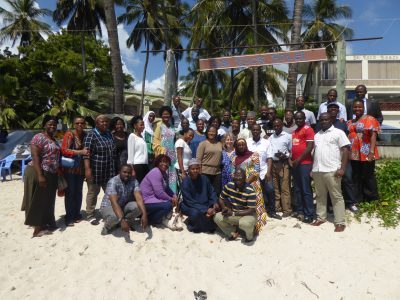
The course participants in Mombasa
The 64th performance-based financing (PBF) course took place in Mombasa, Kenya, from Monday, November 20 to Friday, December 1, 2017.
Five country groups analyzed their health systems and produced detailed action plans to advance PBF in their respective countries. Hereby, the detailed course report.
34 participants attended the course in Mombasa with 21 participants from Nigeria, 5 from Zimbabwe and Liberia, 2 from Lesotho and 1 from South Sudan. Participants were high-level from various Ministries of Health and agencies. 32 participants took the final exam, and the average score was high at 79%. Five participants obtained distinctions. The Sai Rock Hotel is an attractive venue on Mombasa Beach, but there were concerns about internet reliability and room maintenance, with occasional interruptions to the water supply.

The Mombasa village chief and deputy from Nigeria and Liberia
The “village 64” chief, Dr. Daniel IYA, together with his deputy, Dr. Cuallau JABBEH-HOWE, the timekeeper, Dr. Simon NYADUNDU, and the tax collector, Mrs. Lineo MOHLOMI, actively supported the facilitation process, contributed to a congenial atmosphere, and maintained “order” in the village.
The daily evaluations produced scores that, compared with previous courses, were above average. The methods and facilitation scores were 93.9%, 7% above the average of the previous 20 English courses. The participation score was OK at 87.2%, comparable to previous courses. The course organization in Mombasa scored 90.7%, 5% above the average of previous courses. However, participants were less satisfied with Sai Rock Hotel this time, particularly with the water supply and the food, which was considered too monotonous. Timekeeping scored 67.9%, 5% below the average of the previous courses.
The final evaluation showed the program met participants’ expectations, but improvement could be achieved by informing participants in advance about the course. The course methodology was considered good, with an average score of 91%.
THE COUNTRY RECOMMENDATIONS WERE THE FOLLOWING:

Buffalo in Shimba Hills
NIGERIA
- States are encouraged to start PBF programs using multiple financing sources. The Commissioner of Health of Nasarawa State proposed this in Mombasa and is committed to launching a state-wide PBF program.
- Transform Safe One Million Lives (SOML) financing into a pure PBF approach while still targeting state-level disbursement-linked indicators.
- The World Bank may match funding on a 50%–50% basis for States willing to start a pure PBF approach using Internally Generated Revenues, SOML funding, own State resources, or resources from other partners. This would also address the fiscal space for WB-financed PBF programs (preferably at least $US 4.00 per capita per year) while ensuring buy-in from the States and federal-level authorities.
- Review the institutional set-up of the federal-level PBF program and identify the roles and profiles of staff for the NPHCDA and the FMOH.
- Liaise with the 193 participants in Mombasa PBF courses since 2010 to build a critical mass to lobby for purer forms of PBF in more States.
LESOTHO
- Review the PBF design and improve the PBF feasibility score.
- Recommend reviewing the policy on abolishing user fees.
- Advocate for competition between public and private pharmaceutical suppliers.
- Advocate for greater autonomy for health facilities, including using cost-sharing revenues and purchasing inputs from accredited distributors.
- Review and increase the number of indicators to at least 25. Separate quality and quantity indicators, and include community-based indicators.
- Address leadership problems at the central level by better describing each actor’s profile, outputs, and desired service quality, including at the top regulatory level of the Ministry. PBF contracts may formalize these relationships and incentivize with performance payments.
- The regulatory health district authorities should be capacitated and empowered with performance contracts to implement PBF-style reforms.

A forest fruit in Shimba Hills Park
SOUTH SUDAN
- The South Sudan participant proposes joining hands with graduates of the previous Cordaid PBF course (May 2017) to build a critical mass to advocate with government and donors for performance-based programs. An important partner may be the World Bank, which may also advocate for PBF-style reforms.
- Develop and implement a well-designed PBF pilot in areas where the INGO Cordaid is the lead partner. The PBF scheme should include full primary- and hospital-level packages and be adequately funded.
ZIMBABWE
The Zimbabwe team included three high-level officials from the Ministry of Health and two Provincial Medical Officers. They conducted a thorough analysis of Zimbabwe’s RBF program. Zimbabwe’s Ministry of Health and Child Care began piloting performance-based financing in 2011. A 2014 impact evaluation found some encouraging results, and the Ministry adopted PBF nationwide, financed by the World Bank and the Health Transition Fund (now the Health Development Fund). In recent years, maternal mortality, child mortality, ANC coverage, and access to FP have improved, likely in part due to PBF.
However, design problems remain, and participants scored the PBF intervention’s purity at 66% in the World Bank-financed and Cordaid-supported districts. Yet, in the Health Development Fund-financed districts supported by Crown Agents, the score was only 32%. For details on the feasibility scores, see the course report, page 68.
This shows that the PBF program in Zimbabwe is fragmented, as are other donor-driven programs. The government contributes 20% of the PBF budget for the 16 World Bank districts supported by Cordaid, but it contributed nothing to the 42 Health Development Fund districts supported by Crown Agent.
Other problems are the following:
- The government has not yet clearly chosen between providing generalized “free health care” (also supported by DFID, the EU, and the HDP partners) and the World Bank-supported PBF equity approach, which targets the very poor while maintaining user fees for households that can pay.
- The government spends far less than the 15% Abuja standard on health.
- The government’s central medical stores system controls drug and equipment distribution, creating a monopoly.
- PBF contracts exclude private health facilities.
Recommendations:
- Advocate for a purer form of PBF together with previous PBF course participants.
- Advocate that the Ministry of Health change input budget lines from GOZ funding, levies, taxes, and partners towards PBF performance funding.
- Provide all health facilities, public, religious, or private, urban or rural, equal opportunity to obtain PBF contracts.
- Create a more competitive environment for supplying health commodities by removing restrictions that favor monopolies.
- Allow the Directorate of Pharmacy Services to accredit public and private wholesale pharmaceutical companies, including registration requirements and scope of work, to allow entry into PBF.
LIBERIA
- Review the existing PBF institutional and implementation arrangements as well as the package of services to be subsidized.
- Consider introducing user fees and compensating the vulnerable with targeted equity bonuses.
- Separate the functions through the “purchaser-provider split”.
- Introduce PBF contracts not only with health facilities but also with the other actors in the health system.
These recommendations are similar to those previously proposed by groups in Liberia. Yet, by increasing the critical mass of PBF-trained participants from Liberia, Liberia can implement these recommendations.
