The 60th PBF course in Cotonou

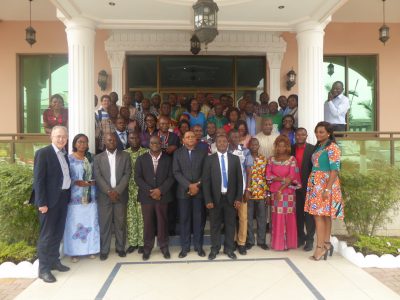
    The 50 participants with the facilitation team in front of the hotel

The 60th PBF course was held in Cotonou from 21 August to 1 September 2017, with 50 participants from Chad (17), Guinea (11), Senegal (7), Côte d’Ivoire (4), Burkina Faso (4), Cameroon (3), Niger (3) and Congo-Brazzaville (1).

Hereby, the detailed course report (rapport).

Due to the high number of participants, it was difficult to meet everyone’s expectations during the plenary sessions while also completing all course modules. This course ended on Friday instead of Saturday, and high-level decision-makers among the participants demanded attention during the plenary sessions. These factors combined explain why during the evaluation the methodology and the timekeeping criteria scored lower than in previous courses and that the final exam result of 68% was slightly below the previous course averages. Continue reading →

PBF in Gabon

Gabon aims to start in early 2018 a new PBF program that will cover a substantial number of regions. Preparations are still under way with the government and the World Bank about the size and the scope of the program. A particularity of this PBF program is that it aims to integrate and strengthen the existing obligatory insurance program, which is suffering from cost-overruns, moral hazard, quality assurance problems and verification problems. Preparations for the PBF program have started during 2017 with a feasibility study, a mapping and rationalization exercise of catchment areas, a two-day seminar with decision makers and, two 14-day PBF courses with in total 70 health professionals.

The second International PBF Course (the 62nd in total) was held in the Solf Hôtel in Lambaréné from the 10th to the 22nd of July 2017. Forty participants took part with eight facilitators and one staff dedicated to the Secretariat. All participants were of Gabonese nationality. 39 participants took the final test of the course and there was 1 distinction of 90% and 3 participants scored 87%.

Hereby the course report (rapport du cours).

Continue reading →

The 61st PBF course in Ngaoundéré

INTRODUCTION AND GENERAL IMPRESSIONS

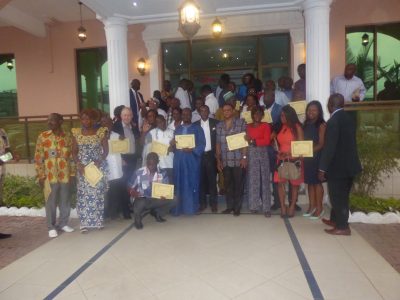
The 50 course participants with their Certificates in the Presence of the Governor

The 61st international PBF course was held at Mentong Palace Hotel in Ngaoundéré, from June 19 to July 1, 2017.

Download the detailed course report (rapport du cours)

The main objective of the course was to extend the PBF reform approach in the northern part of Cameroon and notably in the Regions of Adamaoua, North and Far North with in total 7 million inhabitants. These regions have the poorest reproductive health indicators in the country.

The course was marked by the participation of three executives of the Ministry of Civil Registration (BUNEC) from the central level and the Secretary Generals of three Town Halls in Adamaoua Region. The other participants were from the health sector.

The evaluation of the course showed that the course was a success. There were nine distinctions of participants with scores of 90% or more for the final test.

COURSE FINDINGS AND RECOMMENDATIONS Continue reading →

The 59th PBF course of May 2017 in Mombasa with 7 countries

The 26 participants of the June Mombasa course

The 59th performance-based financing (PBF) course took place in Mombasa, Kenya, from Monday, May 22 to Friday, June 2, 2017.

Hereby, the detailed course report

In general, the PBF course in Mombasa was a success. All participants passed the final exam and the seven country groups produced impressive action plans (see below). The Sai Rock Hotel on Mombasa beach is an attractive venue for learning and thinking about how to improve health systems in the countries represented.

GENERAL OBSERVATIONS / LESSONS LEARNED FROM THE COURSE

The PBF course welcomed participants from seven countries: Cameroon, Ethiopia, Lesotho PBF program, Nigeria, South Sudan, Uganda, and Zimbabwe. The facilitation team included Godelieve van Heteren, Fanen Verinumbe, Claire Rwiyereka, and Robert Soeters. We also welcomed Nicolas de Norman, director of BlueSquare, who shared his spirited vision for data collection and integrating PBF into the DHIS2 system. Over the two weeks of the course, the country teams drafted and refined their action plans to implement and advance PBF in their countries.

View from the conference Hotel

The daily evaluations resulted in above-average scores compared to previous courses. Methods, facilitation, participation, and timekeeping were above average, while hotel services were below average this time.

PBF course content and program materials have expanded considerably since the first course in 2007. Therefore, we progressively condense the messages to save time and tailor the course content as closely as possible to each participant’s needs. The exam’s weight has increased considerably since 2015. As a result, 11% of participants in the last 9 courses in 2015-2016 did not pass the 55% threshold, compared with 5% in the previous 8 courses in 2014-2015. Yet, in this Mombasa course, all participants passed the exam, and we congratulate them.

COUNTRY SPECIFIC RECOMMENDATIONS

Continue reading →

Report Douala course March 6-17

The 47 participants with the Douala health authorities

The 58th International PBF Course was held at Makèpe Palace Hotel in Douala from 6 to 17 March, 2017.

Hereby the course report.

Forty-seven participants took part in this course with six facilitators and three staff dedicated to the Secretariat. Thirty-six participants were from Cameroon, three from Central African Republic, two from Burkina Faso, two from Côte d’Ivoire, 1 from Republic Congo, 1 from Democratic Republic of Congo, 1 from Chad and 1 from Switzerland.

In general, the international PBF course in Douala was a success. 88% of the participants said that the course met their expectations and 91% of them appreciated the teaching materials. The reception by the facilitation team was appreciated by 89% of the participants. The action plans of the 14 working groups were generally of high quality compared to previous courses. Yet, the number of modules and exercises to be shared has increased sharply in recent years and, as a result, 42% of participants said the time for the course was too short. The course facilitation will also have to make difficult choices on which modules to share with each individual participant and how to organise this modular approach adapted to the needs of each participant.

The general recommendations of the course

  • Sunset during the social event in Limbe

    Cameroun: Assure the regular payments of PBF invoices by the national PBF Unit. Payment delays are often between 6 and 12 months, which have put at risk the progress of the PBF program and has frustrated all actors, but especially those who depend for a large extent on the PBF subsidies such as the regulatory authorities and the CDV Agencies. At health facility level, this also applies for those activities that are offered free-of-charge to the population such as the support for the vulnerable, home visits, tuberculosis treatment and family planning services. Performance contracts with the national PBF Unit may solve these delays and this should already start in April 2017. New delays in the payment schedule most have consequences for the variable part of their remuneration. The directorates of the MOH should also be put under performance contracts starting from the 1st of April in at least one directorate.

  • Improve the economies of scale of the operations of the district health management teams. Districts should be rationalised into health district units covering around 150,000 people. This implies cutting certain large health districts such as Deïdo in Douala with a population of 800,000 into at least three new health districts. Other districts should be given a principal contract whereby they supervise those districts, which have less than 40,000 population. In the small districts, the medical doctor may concentrate on the hospital activities and leave the regulatory role to another medical doctor operating from another larger health district. All this also to avoid conflicts of interest.
  • Happy moments after obtaining the course certificate

    Set up urgently the CDV Agency for the Central Region with a technically well-equipped team recruited on the basis of competence and competition. In the legal sense, the CDV Agency should be under the umbrella of the Regional Fund for Health Promotion, but it should have a large degree of autonomy to avoid any potential conflicts of interest with the RFHP and notably concerning the distribution of drugs.

  • Encourage Regions and CDV Agencies to make the most effective use of their PBF action research budget. Research topics should be identified and discussed during district validation meetings. The research budget should be made available to any actor capable of conducting quality research and could include health facility staff, regulators, members of public health schools. Moreover, it is encouraged that regions seek collaboration with international research institutes to further enhance the quality of their action research.
  • Ensure the autonomy of the PBF health facilities by applying derogations for: (a) Authorizing health facilities to open separate commercial bank accounts, which they also control; (b) Applying the market price for the purchase of inputs instead of the higher mercurial prices and; (c) Authorizing health facilities to purchase their inputs from accredited distributors operating in competition.
  • Encourage the quick introduction PBF in the Education sector in Cameroon and support the action plan of the Education sector group in Douala.
  • Several country teams in the course (Burkina Faso, Chad, CAR (Bekou Fund), DRC, the Republic of Congo and Ivory Coast) propose that the design of their PBF interventions should improve and include more PBF best practices. Details can be found in the follwong paragraphs.

The recommendations from the 14 working groups

Continue reading →