
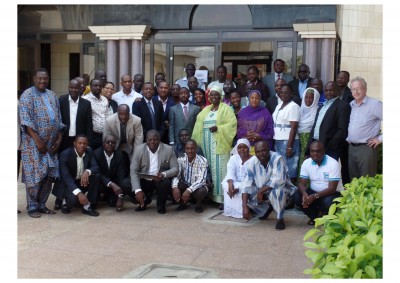
The 39 course participants of the Cotonou course
The 50th PBF course was held in Cotonou from October 12 to 23, 2015 with thirty-nine participants from Chad (16) Niger (10x), Haiti (4x) Cameroon (3x), DRC (2), Comoros (2x), Ivory Coast (1x) and Benin (1x).
Six participants received a certificate of distinction with a score of 90% or more.
Here is the course report (rapport)
COUNTRY ANALYSIS
Benin
Strategies to strengthen the health system and the RBF in Benin:
- Integrate other MOH departments in the consultation about the PBF;
- Obtain the government’s commitment to maintain an appropriate level of governance to ensure the success of the RBF, including progress towards decentralization;
- Provide more autonomy to health facilities to purchase essential drugs, equipment and recruit staff;
- Ensure that the innovative initiatives (community RBF, quality improvement bonuses, involvement of the private health sector, …) are not diverted into vertical programs, but retain their cross-cutting nature;
- UNICEF, through its mission to the realization of the rights of children in accordance with the Convention on the Rights of the Child (CRC), is part of this process in Benin not only to strengthen the acquired high-impact package at community level but also at health facility level to fight against child, maternal, and neonatal mortality.
Cameroon
- Advocate for derogations for the PBF structures and regulatory authorities.
- Recruit more quality staff for the Regional CDV Agencies
- Advocate for the inclusion of bonuses for vulnerable regions

The sculptures of Benin
Comoros
- Conduct a feedback meeting within the MOH on the PBF training
- Conduct a restitution with other stakeholders, such as the Ministry of Finance, AFD, Gavi, UNICEF, UNFPA, CCM, the Ministry of Education, FENAMUSAC, MAEECHA, etc.
- Organize the external review of the current pilot PBF Project;
- Implement the recommendations of this review;
- Mobilize additional resources;
- Scale up the PBF program.
Ivory Coast
Ivory Coast is scaling up PBF, which is considered an effective instrument to improve health system performance and a precursor to radical health system reforms. The Ministry and other stakeholders already own and support the PBF.
Niger
- Assign staff to the PBF unit required for its operation
- Organize a round table of partners to mobilize funds to ensure PBF
- Advocate for the opening of a PBF line in the national budget
- Integrate private health facilities in PBF
- Train and supervise community workers on the PBF indicator “Household Visit”
Chad
- Organize meetings at national and regional levels on the 50th PBF course
- Organize a high-level advocacy meeting and training on PBF
- Establish a pool of trainers in PBF
- Advocate within the MSP for more autonomy at health facility level to procure essential drugs at accredited wholesale organizations outside central medical stores;
- Provide a budget line for the PBF investment units at health facility level
- Conduct the rationalization of the health facilities in the PBF project area
Haiti
 Include 3 indicators on HIV / AIDS, malaria, and tuberculosis in the PBF package;
- Brief the contracting team responsible for the implementation of the International Strategy on the PBF course;
- Revise the indicators;
- Propose inserting the Investment Units.
Democratic Republic of Congo
Difficulties
- Low budget allocated to the health sector;
- Strong centralization of the health system resources;
- Poor resource management: corruption and lack of accountability.
