
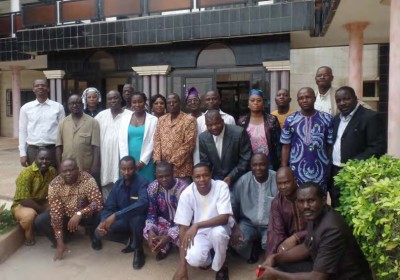
The 22 participants and the facilitation team of the 45th PBF course
The 45th PBF course in Cotonou took place from 23 March to 3 April 2015, with 22 participants from Niger (10), Benin (5), Cameroon (3), Burkina Faso (3), and Ivory Coast (1).
The participants appreciated the course, with an average score of 85% on the daily evaluations, compared to 79% for the 22 previous French courses. Satisfaction with the facilitation was 93%.
Here is the course report (rapport).
CONCLUSIONS for EACH of the PARTICIPATING COUNTRIES
Beach Cotonou
Niger will start PBF in the health district of Boboye in the Dosso region, with technical support from the World Bank, covering a population of 400,000.
Participants’ recommendations for Niger:
- Authorities should apply all PBF best practices in the pilot project;
- The course group will inform and create awareness about PBF among the administrative authorities, local elected officials, partners, etc ;
- The project should establish a Regional Contract Development and Contracting Agency instead of a central one;
- The project should conduct the mapping of public and private health facilities in the pilot area and sign contracts (primary and secondary) both with public and private health facilities;
- Define the indicators for the community PBF activities.
Benin
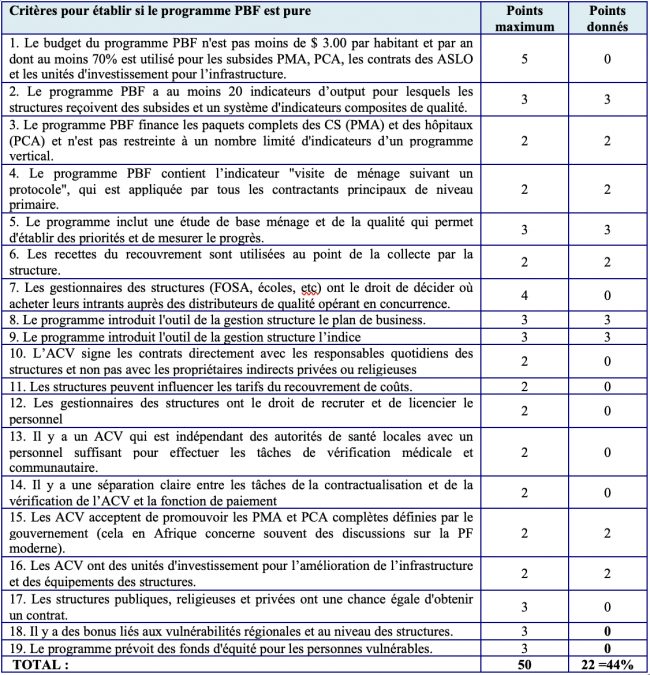
The country has achieved good results since 2012 with the RBF program, notably: (1) improved health worker motivation; (2) improved professional quality; and (3) ownership of the peer assessment approach by district hospital staff.
Yet, the program still has a low RBF feasibility score of 44%.
The Benin team conducted an analysis of the RBF program’s feasibility score in the country, revealing the following issues:
- A budget of less than USD 4 per person per year ;
- Limited autonomy for health facilities due to centralized human resources management, restrictions on sourcing supplies from multiple distributors, and a lack of authority to set cost-recovery rates ;
- Exclusion of private health facilities from eligibility for a primary RBF contract ;
- Absence of geographic equity bonuses for vulnerable regions, districts, and health facilities ;
- Lack of equity indicators that allow reimbursement of care for vulnerable individuals, thereby exempting them from direct cost-recovery fees.
 Strategies to strengthen the health system and the RBF in Benin:
- Integrate other MOH departments in the consultation about the PBF;
- Obtain the government’s commitment to maintain an appropriate level of governance to ensure the success of the RBF, including progress towards decentralization;
- Provide more autonomy to health facilities to purchase essential drugs, equipment and recruit staff;
- Ensure that the innovative initiatives (community RBF, quality improvement bonuses, involvement of the private health sector, …) are not diverted into vertical programs, but retain their cross-cutting nature;
- UNICEF, through its mission to the realization of the rights of children in accordance with the Convention on the Rights of the Child (CRC), is part of this process in Benin not only to strengthen the acquired high-impact package at community level but also at health facility level to fight against child, maternal, and neonatal mortality.
Burkina Faso started a PBF pre-pilot in 2010 in three health districts. The pilot was extended in 2014 to 15 health districts, covering 4.2 million people (25% of the BF population). The results are satisfactory, but the feasibility scan score of 68% could still be improved.
Participants’ recommendations for Burkina Faso:
To the Ministry of Health: (1) Continue the expansion of PBF to all districts in the country; (2) Ensure the sustainability of the PBF strategy; (3) Ensure proper implementation of all PBF best practices.
To the partners: (1) Provide more funding for PBF; (2) Assist Burkina Faso towards the upscaling of PBF to all districts.
The Cameroon – Far North Region.
The Cordaid-funded PBF pilot started in January 2012 and has produced satisfactory results. The local Contract Development and Verification Agencies is the Association for the Promotion of Health in the Far North (APROSEN). The feasibility scan score is 66%.
Participants’ recommendations for Cameroon:
-

Traditionel hut in Ouida
Integrate the health facilities currently covered by Cordaid and APROSEN in the PAISS / World Bank PBF program;
- Develop emergency PBF indicators to respond to the insecurity in the Far North caused by the Boko Haram insurgency;
- Review and improve the PBF equity indicators to assist the vulnerable;
- Take into account that the local CDV Agency (APROSEN) already has good knowledge of the region.
Ivory Coast. The government and the World Bank plan to implement a PBF program for around 3.5 million inhabitants. Few private organizations in the Ivory Coast are yet involved in the various PBF functions. To address this gap, the Global Challenge Corporation offers technical assistance.
